We Just Stood There
What I learned about pride between a market square in Cologne and Fifth Avenue.
What I learned about pride between a market square in Cologne and Fifth Avenue.
I grew up in the seventies, when the world still seemed to be holding the door open. There was something left over from the sixties in the air — a beatnik hum, a sense that everything was still possible, that you could become whoever you decided to be. And then disco arrived and turned that quiet promise into something enormous. Bombastic, even. The lights, the bass you could feel in your chest, the strangers who became family for the length of a song.
For me, in those years, everything was music and everything was emotion. I didn't yet know that I was standing at the beginning of a story. I just knew that I was happy, and that being happy felt like a kind of secret most people hadn't been let in on.
My first Pride wasn't called Pride, and it wasn't really a parade. It was a handful of drag queens gathering at a market square in Cologne and marching through the city. That was it. A few people in feathers and heels, walking down ordinary German streets in broad daylight.
I watched from the curb with two feelings fighting inside me at once. The first was what the hell are they doing. The second, arriving a half-second later and never leaving, was wow — what courage. I didn't have the words for it then, but I had seen something true: that simply being visible could cost you something, and that paying that price was one of the bravest things a person could do.
I went home unsettled. I didn't understand yet what I had been looking at. It would take me years, and an ocean, to understand it.
When the eighties came, the warmth drained out of everything. The decade turned cool, slick, and all about money. The music got harder, the clothes got sharper, and a certain tenderness that the seventies had carried simply… left the room.
And then the dying started.
I won't reach for big words here, because the truth doesn't need them. The party never quite stopped, but now there was someone standing at the edge of every room who hadn't been there before. Friends got thin. Then they got sick. Then they were gone, often with a speed that left you no time to understand it. To be gay in those years was to be an outsider — big time — and to learn that the world you'd been so happy in could turn on you, or simply look away while you buried people you loved.
That is the part of my history I carry most carefully. Not because it makes me special, but because so many of the people who lived it aren't here to tell it themselves.
In 1988 I moved to New York. I had imagined the city for years, and somehow it was bigger than the imagining — full of bigger-than-life creatures, every one of them seemingly built from pure nerve.
Among them I met someone I had secretly admired for a long time: Quentin Crisp. The naked civil servant himself — a man who had survived an upbringing so repressive it should have folded him in half, and who instead walked through the world flamingly, lavishly himself, entirely unbothered by anyone's opinion of how he ought to be. To sit near that kind of courage is to feel your own spine straighten a little.
It was in New York, in that company, that the thing I'd half-seen on a curb in Cologne finally came into focus. Pride — that's what we called it then — was a demonstration and a party. But underneath the music and the color, first and foremost, it was a demonstration for equal rights. A political act wearing a costume. And once I understood that, I couldn't un-understand it. It began, quietly, to organize the way I saw everything — including, eventually, the choices I would make about where I gave my work and my loyalty.
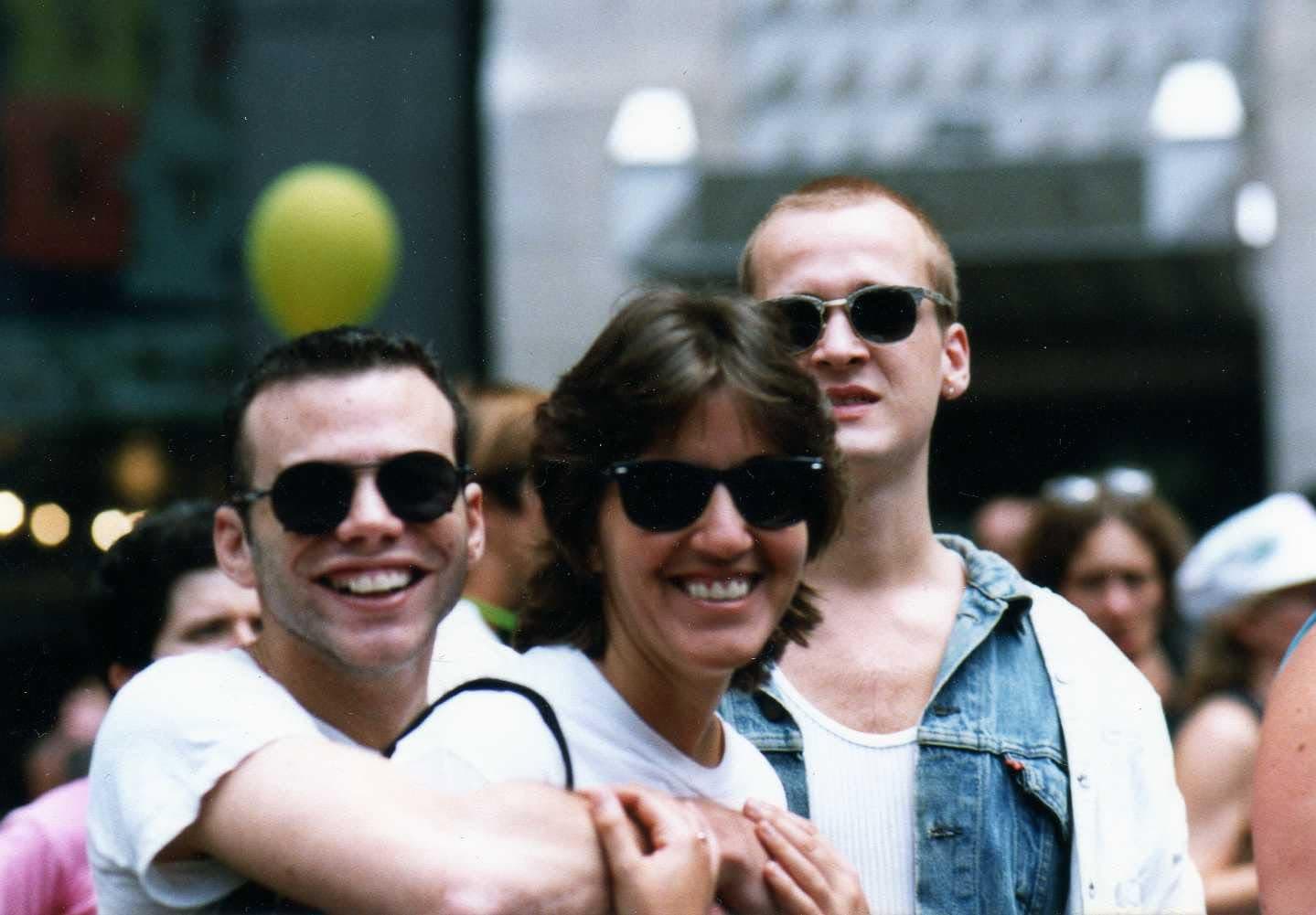
There's a photograph I keep from those years. Three of us pressed together in a crowd — me, my then partner, and his classmate from NYU Law School. Sunglasses against the summer glare. A yellow balloon floating somewhere over our shoulders. Behind us, a sea of people I half-knew and wholly belonged to.
We are laughing. You can see it even through the dark lenses — that particular wide-open laughter you only manage when you feel completely safe among your own.
This was my tribe. My found family. The people you'd later see me grieve, and the reason I'd one day stand still on an avenue and let strangers scream at me without flinching. In a time that wanted us invisible, joy like this was not an escape from the fight. It was the fight. Standing in the open, arms around each other, refusing to be ashamed — there are demonstrations louder than that one, but I'm not sure there are braver ones.
I had the honor, one year, of walking for David Spada in the New York Pride parade — the designer who, among many other beautiful things, made Grace Jones's wire pieces. To march on Fifth Avenue in that company was its own kind of glory.
But the moment I remember most clearly isn't the marching. It's the standing.
We had stopped to stand in silence for our friends who had died of AIDS. And as we stood there, born-again Christians surged in from both sides of the avenue, screaming at us to go back into the closet, to be ashamed, to disappear.
We didn't shout back. We didn't move. We just stood there — quiet, holding the silence we had chosen — while they screamed.
I have thought about that silence for more than thirty years. At the time it felt like the hardest thing in the world to do nothing, to answer rage with stillness. Only later did I understand that the stillness was the whole point. We weren't being passive. We were standing for people who could no longer stand for themselves, and we would not let anyone's noise move us off that ground.
I'm sixty now, and Pride has become a global celebration. Cities glow with it. Brands march in it. Millions of people who would once have watched nervously from a curb, the way I did in Cologne, now dance down the middle of the street.
And I love it. I want to say that plainly, because what comes next is not a complaint. The joy is eal and it is hard-won and the people dancing have every right to every minute of it.
But I miss something. I miss the demonstration. I miss the part that wanted to create impact and drive change, the part that knew exactly what it was risking and stood there anyway. So much was won — marriage, adoption, protections that would have seemed like science fiction to the people I stood beside on Fifth Avenue. I never wanted those things for myself. I never wanted to marry or adopt children. But I have never for one second doubted that you should be free to.
Celebration is a beautiful thing. But celebration that forgets its own cause forgets the people who paid for it.
So here is what pride has come to mean to me, after all of it.
Pride was never really about getting what I wanted. It was about standing for what you deserve — in feathers when the moment called for feathers, and in total silence when silence was the most defiant thing a body could do.
That instinct never left me. It became a compass, and I've quietly steered by it ever since — including in something as ordinary as deciding whose company to keep, and whose work to do. I've always asked, of every place that wanted my time and my talent, a simple question: when it matters, which way would you stand? I've tried only to give myself to the ones I believed would stand the right way.
I never wanted to marry. I never wanted to adopt. But damn — I would always fight for your right to do both.
More than thirty years later, with everything going on in the world right now, that old silence on ;Fifth Avenue doesn't feel like history to me. It feels current. It feels necessary. And if I'm honest, it feels like it's asking the rest of us to remember how to stand still, together, and not be moved.
We just stood there.
It was the proudest thing I have ever done