Adjusting hydro reservoir targets and generation outlook in CWE
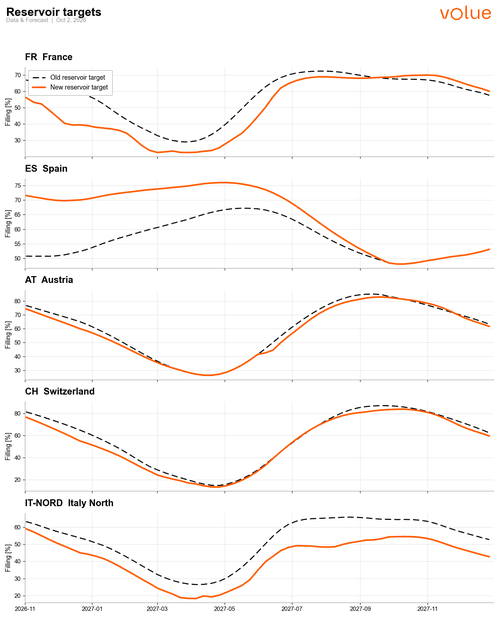
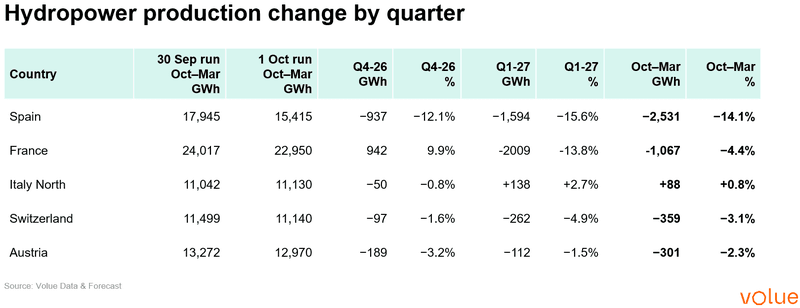
Volue updated its hydro reservoir targets for France, Switzerland, Spain, Austria and Italy Nord on October 1, 2026, the model area referred to below as Italy North. The revision raises the target in Spain and relaxes it in France, Switzerland and Italy North. For Spanish producers, the result is 2.5 TWh less expected hydropower generation across October to March. For Alpine producers, the water mostly stays in the system and moves to a different quarter.
The update reflects the hydrological situation in the Alps and Iberia as of October 1. Reservoir targets are the constraint that tells a mid and long-term market model how much water to carry forward rather than convert to megawatt hours now. Change the target and you change the dispatch schedule, the generation profile, and the price curve that follows from it.
Five price areas were revised. Spain moves to a higher filling target. France, Switzerland and Italy North move to relaxed targets. Austria was revised, but the change is small relative to the size of its reservoirs.
A higher target holds water back. The model stores more and generates less, because it must reach a fuller reservoir by the end of the horizon. A relaxed target does the opposite. It gives the model more freedom over when to release, without necessarily changing how much it releases in total.
That distinction matters for anyone planning winter production. One revision changes volume. The other changes timing.
Reservoir targets
Spain's expected hydropower generation for October to March falls by 2.5 TWh, or 14%. October is almost unchanged. Every month from November through March is 12 to 16% lower.
The driver is the combination of historically high reservoir levels right now and an expected moderate inflow over the winter. With limited inflow ahead and a higher target to meet, the model protects storage instead of spending it. Spanish system data is published by Red Electrica through esios for producers who want to track how the physical position develops against this view.
For a Spanish hydro portfolio, the practical read is a flatter winter production plan with less discretionary volume from November onward.
In France and Italy North, relaxed targets change the shape of the year more than the total.
France gains roughly 20% in October and November. January through March falls by 8 to 17%. Italy North ends the winter with marginally more hydro: October is 5% lower, December through March is 2 to 4% higher. Switzerland shifts generation out of the last quarter of 2026 and into the first quarter of 2027. Austria shows no discernible change.
Flows across these borders are visible on the ENTSO-E Transparency Platform, and Italian system data on Terna's transparency report.
Gas moved at the same time, which complicates the attribution. Gas prices rose by approximately 2.2 EUR/MWh on September 30, 2026. Any price change in the model since then carries both effects.
Broad trends still emerge. Spain shows the largest increase: 5.1 EUR/MWh on the Q4 2026 contract and 7.3 EUR/MWh on Q1 2027. The other Alpine countries show roughly 4 EUR/MWh on both contracts. Austria shows approximately 2.5 EUR/MWh.
The spread between Spain and the Alpine areas is the signal worth isolating. Spain is pricing a genuine volume constraint. The Alpine areas are pricing a timing change plus the common gas move.
Gas covers most of it. Around 70% of the hydropower loss in Iberia is replaced by gas generation, an increase of 1.7 TWh. Nuclear adds a further 10%, or 0.25 TWh. The remainder comes from reducing exports.
Italy North behaves differently. Gas production drops, with marginally higher hydro production and imports covering the shortfall. In the other Alpine countries, French nuclear and increased German exports cover most of the gap.
For a producer, the energy balance is the part to act on. More of the Iberian winter requirement is now met by gas, which raises the weight the gas curve carries in the Spanish outlook relative to the previous targets.
Three decisions change on the back of this update.
Spanish portfolios should re-examine how much flexible volume they have assumed for November through March, since the model now holds back water that previous runs released. French portfolios should pull value forward, because the upside sits in October and November rather than in the first quarter. Swiss and Italian portfolios should re-run winter dispatch on the new quarterly shape before committing hedges.
Volue's production and consumption forecasts and the fundamental market model feed the same chain: forecast, plan, rebid, execute. A target revision this size enters at the top of that chain and moves everything below it.
The same logic applies wherever storage is the constraint. SKL's work on hydro flexibility shows what disciplined reservoir management is worth when water is scarce rather than abundant. Volue's long-term power price view sets the horizon these winter decisions sit inside, and the gas price scenario analysis covers the fuel-side risk that now carries more weight in Iberian pricing.
One operational note for subscribers: French reservoir filling targets were updated in multiple steps between September 20 and 30, 2026. The changes are therefore not visible between two consecutive issues of the Fundamental and mid-term Market model.
Reservoir targets will move again as the winter hydrology resolves. Each revision is a reason to re-run the winter plan rather than carry the annual view forward.
The Fundamental and mid-term Market model carries these reservoir targets, the generation outlook for every price area, and the price curves that follow from them. Subscribers received the revised run on October 1, 2026.
Volue's mid and long-term market analysis gives production planners the horizon these winter decisions sit inside, updated as the hydrology moves.

About the author
Zaheer Ahamed is a Senior Analyst at Volue. He works on hydrological modeling and fundamental market analysis across Central Western Europe, and he sets the reservoir filling targets behind this outlook.